GPT = Generative Pre-trained Transformers
Goal: tokenize sentences (break up words and give them token IDs)
Two types:
(1) Word Token Embeddings (WTE)
-
Context-less meanings of each
-
Can learn during training
(2) Word Position Embeddings (WPE)
-
Represents token’s position in sentence
-
Cannot learn during training
What’s new? Multitask learning (can perform multiple NLP tasks without changing the architecture of the transformer). BERT has to add on layers to perform multiple NLP tasks, making it non-multitask learning.
Decoder stack
Only has a decoder, not encoder. Decoders are a combination of multi-head attention and feed forward layers. GPT has Byte-level tokenization: special token <|endoftext|> added to the end of a tokenized sequence
Indicates: finished creating text
Model: auto-regressive = generates word and tokens until endoftext token hit
Ġ = represents the beginning of a word
Note: GPT treats spaces are parts of token; the same word with a space in front of it versus no space will be encoded differently
Note: GPT is cased when tokenized
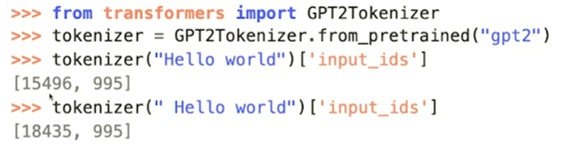 GPT’s Tokenization – Source: Sinan Ozdemir – Introduction to Transformer Models
Attention in decoders = Masked multi-headed attention
The same self-attention equation, but now we get into what softmax does to matrix — Masked multi-headed attention cancels out the attention scores after each token
Reason: don’t want the model to see context after the word it’s currently on, able to predict next token only knowing past tokens
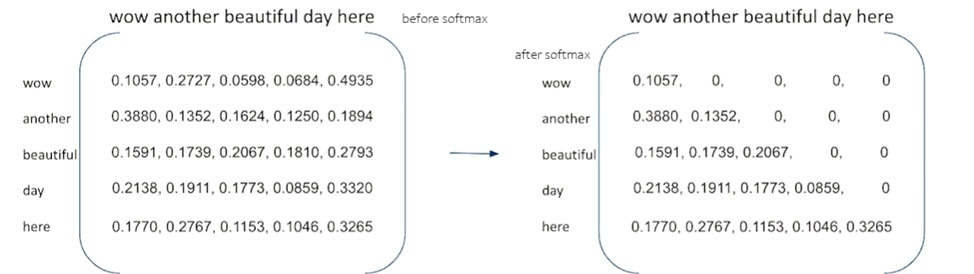 Softmax change to matrix – Source: Sinan Ozdemir – Introduction to Transformer Models
GPT practices inference. GPT predicts words one by one: Calculate word → recalculate attention of word → mask it (access to this current word) → predict next word
Input: My friend was right about this class. It is so fun!
After tokenized a sentence looks like:
torch.size([1, 12, 13, 13])
1 is the batch size, 12 heads in final encoder, 13 by 13 = 13 tokens in input
Now masked
The hidden state represents the representation of each token
response.hidden_states[-1].shape #-1 means decoder
torch.Size([1, 13, 768])
1 batch, 13 tokens, each token has a vector size of 768 (768 numbers in each vectors that represents the token)
Few-shot learning
What it makes it so popular is its ability to train multiple tasks at once. Issue is inputting in so much information comes with bias. AI Engineers should be aware of the bias and do what we can to minimize or eliminate this bias.
That being said, what if a model has to perform a task it has never done before?
(1) Few-shot learning: perform new task with multiple examples
-
given: task description + as many examples that fit into the context window
-
how: assign +/- sentiments (Sentiment Analysis)
print(generator("""Sentiment Analysis
Text: I hate it when my phone battery dies.
Sentiment: Negative
###
Text: My day has been really great!
Sentiment: Positive
###
Text: Not a fan when it is cloudy
Sentiment:""", top_k=2, temperature=0.1, max_length=55)[0]['generated_text'])
Output: able to say cloudy weather has a negative sentiment
Setting `pad_token_id` to `eos_token_id`:50256 for open-end generation.


Sentiment Analysis
Text: I hate it when my phone battery dies.
Sentiment: Negative
###
Text: My day has been really great!
Sentiment: Positive
###
Text: Not a fan when it is cloudy
Sentiment: Negative
(2) One-shot learning: perform a new task with 1 example
- given: task description + one example
print(generator("""Question/Answering
C: Google was founded in 1998 by Larry Page and Sergey Brin while they were Ph.D. students at Stanford University in California. Together they own about 14 percent of its shares and control 56 percent of the stockholder voting power through supervoting stock.
Q: When was Google founded?
A: 1998
###
C: Hugging Face is a company which develops social AI-run chatbot applications. It was established in 2016 by Clement Delangue and Julien Chaumond. The company is based in Brooklyn, New York, United States.
Q: What does Hugging Face develop?
A: social AI-run chatbot applications
###
C: The New York Jets are a professional American football team based in the New York metropolitan area. The Jets compete in the National Football League (NFL) as a member club of the league's American Football Conference (AFC) East division.
Q: What division do the Jets play in?
A:""", top_k=2, beams=2, max_length=215, temperature=0.5)[0]['generated_text'])
Output: able to answer which division Jets play
Setting `pad_token_id` to `eos_token_id`:50256 for open-end generation.


Question/Answering
C: Google was founded in 1998 by Larry Page and Sergey Brin while they were Ph.D. students at Stanford University in California. Together they own about 14 percent of its shares and control 56 percent of the stockholder voting power through supervoting stock.
Q: When was Google founded?
A: 1998
###
C: Hugging Face is a company which develops social AI-run chatbot applications. It was established in 2016 by Clement Delangue and Julien Chaumond. The company is based in Brooklyn, New York, United States.
Q: What does Hugging Face develop?
A: social AI-run chatbot applications
###
C: The New York Jets are a professional American football team based in the New York metropolitan area. The Jets compete in the National Football League (NFL) as a member club of the league's American Football Conference (AFC) East division.
Q: What division do the Jets play in?
A: American Football Conference (AFC) East
(3) Zero-shot learning: perform a new task with no examples of how/what to do
- given: prompt
# Same question as before, with no previous examples ie Zero-shot learning. Still works
print(generator(
    '''Question/Answering
C: The New York Jets are a professional American football team based in the New York metropolitan area. The Jets compete in the National Football League (NFL) as a member club of the league's American Football Conference (AFC) East division.
Q: What division do the Jets play in?
A:''',
    top_k=2, beams=2, max_length=80, temperature=0.5)[0]['generated_text']
)
Output: Answered with New York Jets
Setting `pad_token_id` to `eos_token_id`:50256 for open-end generation.


Question/Answering
C: The New York Jets are a professional American football team based in the New York metropolitan area. The Jets compete in the National Football League (NFL) as a member club of the league's American Football Conference (AFC) East division.
Q: What division do the Jets play in?
A: The New York Jets play in the American Football Conference East
Prompt Engineering
Multi-task Prompt Engineering – Teaching GPT multiple tasks
Fine-tuning GPT - Update the attention heads for each task, but do it in a bigger scale
2 prompts = 1 for sentiment analysis (scores like: positive, neutral, negative) + 1 for summarization
1 text = added to prompts, indicating what GPT should accomplish
MODEL = 'distilgpt2'

tokenizer = GPT2Tokenizer.from_pretrained(MODEL) #loads up tokenizer

tokenizer.pad_token = tokenizer.eos_token #set pad token to avoid warnings

#add two prompts, one for each task
SENTIMENT_PROMPT = 'Sentiment Task'
SUMMARIZE_PROMPT = 'Summarize Task'
SENTIMENT_TOKEN = '\nSentiment:' #tell GTP2 when to start task
SUMMARIZE_TOKEN = '\nSummarize:' #tell GPT2 when to start task
reviews['sentiment_text'] = f'{SENTIMENT_PROMPT}\nReview: ' + reviews['Text'] + SENTIMENT_TOKEN +  ' ' + reviews['Sentiment'].astype(str) #adds sentiment prompt to review #sentiment_token at end to start task for a sentiment prediction

reviews['summarize_text'] = f'{SUMMARIZE_PROMPT}\nReview: ' + reviews['Text'] + SUMMARIZE_TOKEN +  ' ' + reviews['Summary'].astype(str)
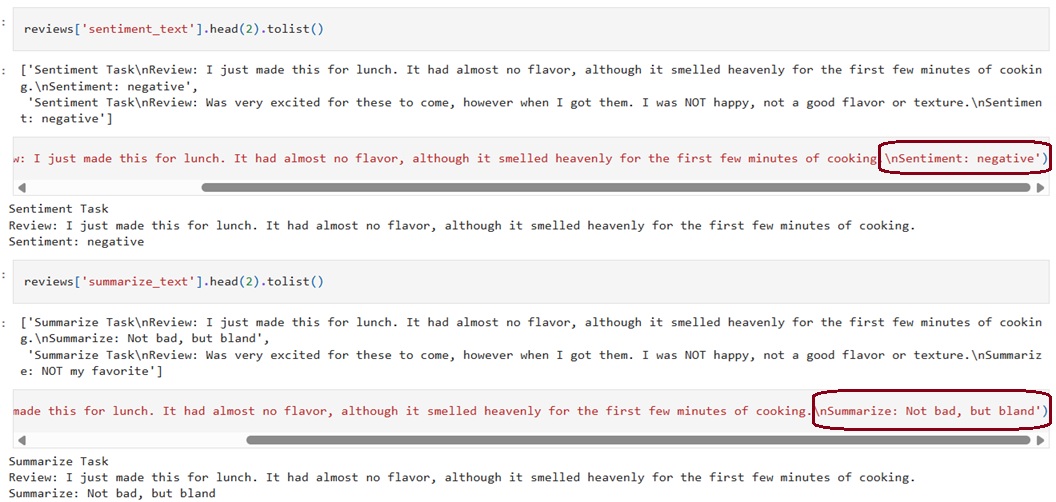
With all training examples: tokenize → split → load into distilgpt2 model → use collator to batch training exercises = ready to train model → use trainer argument to train model
trainer.evaluate()
The more you train, the more (hopefully) your loss function decreases, ergo the more accurate a models’ predictions are with the new data. Once in a good place with the loss function, can save the model.
trainer.save_model()
Every batch of data now has two tasks at once. Can now train multiple NLP tasks in a pipeline.
Run prompts through model again and see response:
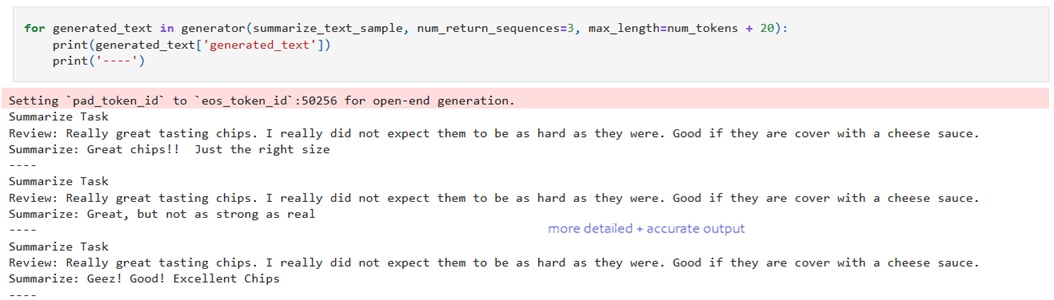
When fine-tuning the prompts should be short and the labels should hold semantic meaning of what the task is trying to accomplish.
T5
T5 = Text to Text Transfer Transformer
-
Encoder stack and decoder stack
-
Encoder is bidirectional – can process entire prompt simultaneously
-
Multi-task learning (can perform multiple NLP tasks without changing architecture)
Has 4 skills:
-
English → German translation
-
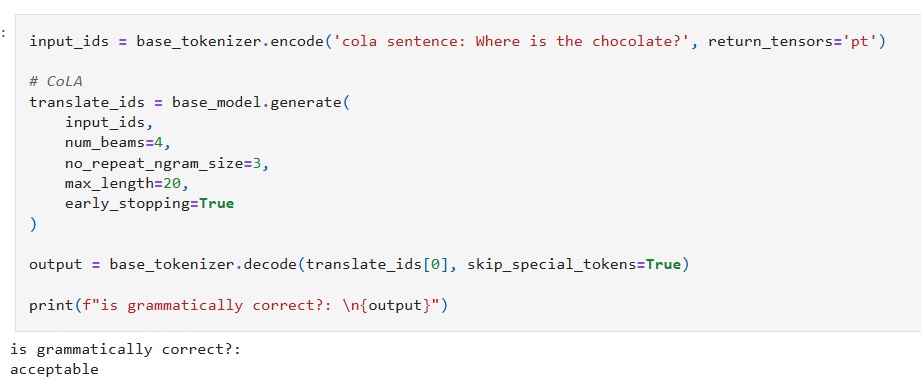
cola = The Corpus of Linguistic Acceptability – tests how grammatically correct a sentence is
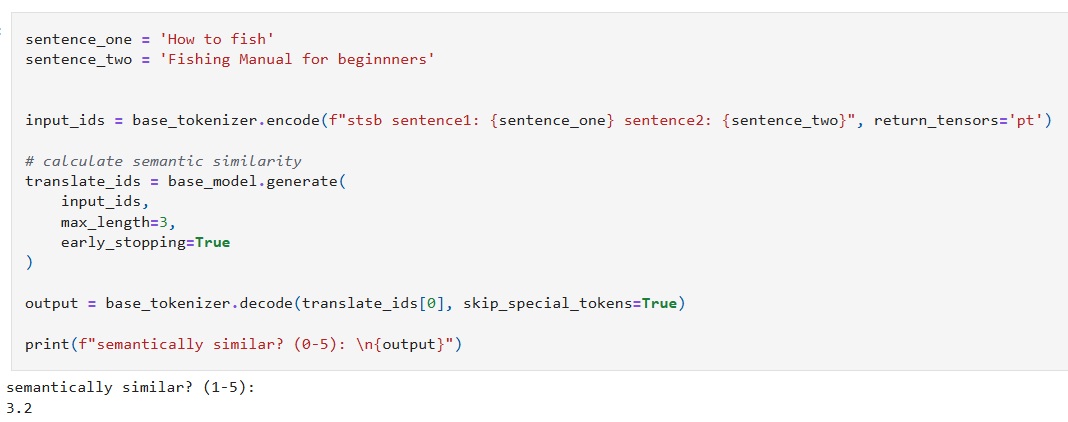
- stsb = semantically text similarity benchmark = given 2 phrases how close are they semantically
- summarizes
Something new:
-
Deshuffling: shuffles input randomly → predicts the original word
-
Model understands how words are used in a sentence and the importance of order of words
When pretraining T5, engineers threw in unsupervised and supervised tasks (translation, linguistic acceptability, semantic text similarity, summarization)
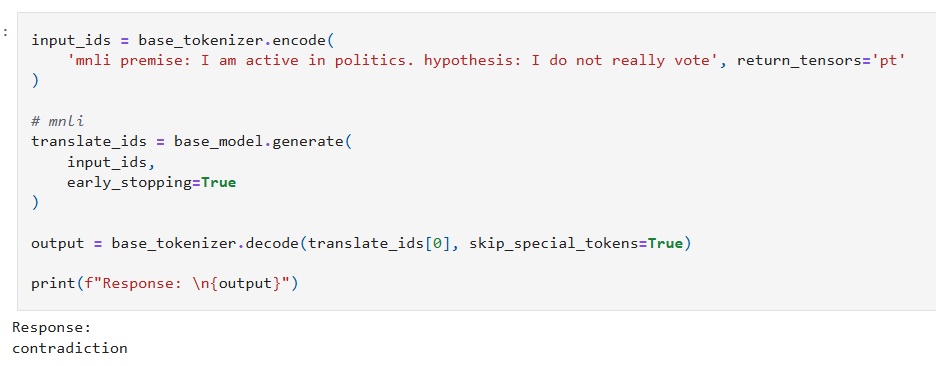
MNLI - Multi Genre Natural Language Inference
- does a premise imply (entailment), contradict (contradiction), or neither (neutral) a hypothesis